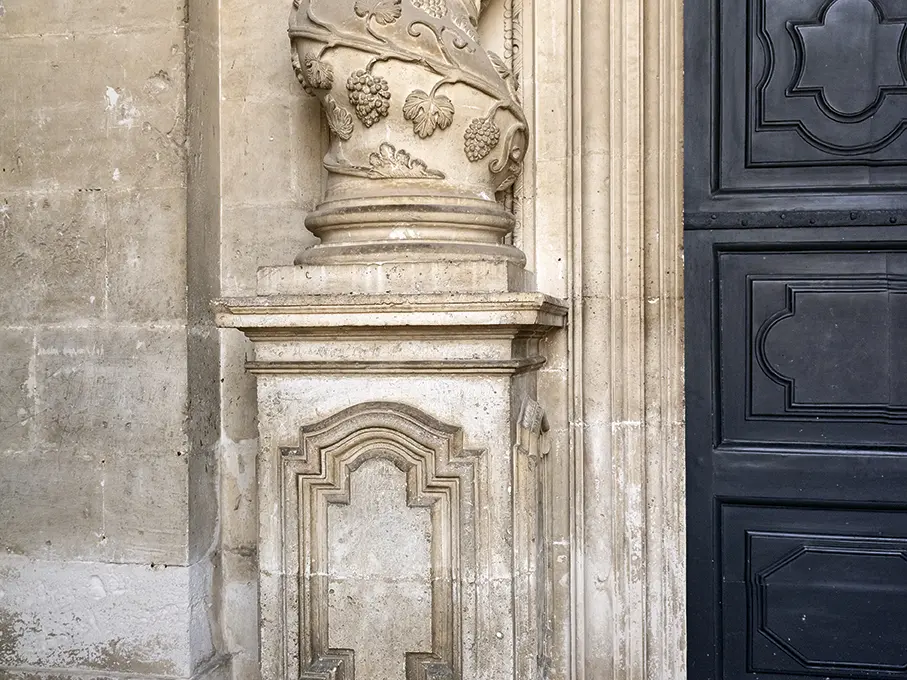
There is no other ancient temple that has endured to the present day in a guise that both preserves its structure and illuminates its new Christian function quite like the Duomo of Syracuse. The eight-meter-high columns that make up its left side are clearly visible from Piazza Minerva. The three-dimensionality of the first four columns, embedded into the façade, the masonry and the crenellations, is hinted at, as they are firmly planted on their stylobate. But this is simply an invitation to enter the church; inside, the columns emerge from the counter-façade as well, dominating the visual space. The central nave has the same dimensions as the central structure of the original temple, and the side walls of the Greek cella can be seen in the presbytery.
Like the temple of Himera, this temple was also built following the glorious battle of 480 BC in which the Syracusan tyrant Gelon triumphed over the Carthaginians. In the ancient world, its fame was such that, according to a passage in Cicero’s Verrine Orations, it was spared by Marcellus when, conquering Syracuse in 212 BC after a two-year siege, he took nearly everything else in the city and carried the booty back to Rome, thus sparking the Romans’ love of Greek art. Cicero recalls that Agath- ocles had added a cycle of paintings to the building depicting his battles against the Carthaginians and a procession of twenty-seven Syracusan tyrants. Another ancient source, Athenaeus of Naucratis, reports that the temple held a gilded shield, the aegis of Athena, which according to Mirabella was set atop a square tower in the center of the building. When it was struck by the sun’s rays, it was the last image that remained impressed in the mind of anyone leaving Syracuse.
After its transformation into a Christian church in the Byzantine era, and the Arab invasion, the Duomo was reconsecrated following the Norman invasion. The initial adaptations, which respected the ancient structure of the temple, certainly date to this period of history, while successive transformations were motivated mainly by collapses due to two earthquakes (1542 and 1693). Orsi was responsible for renovations completed in 1925 to free the columns from Baroque superimpositions. Archeological analyses carried out by Giuseppe Voza and published in 1999 clarified that the area in front of the temple of Athena had been levelled and enlarged to lend it the proper monumental prominence.