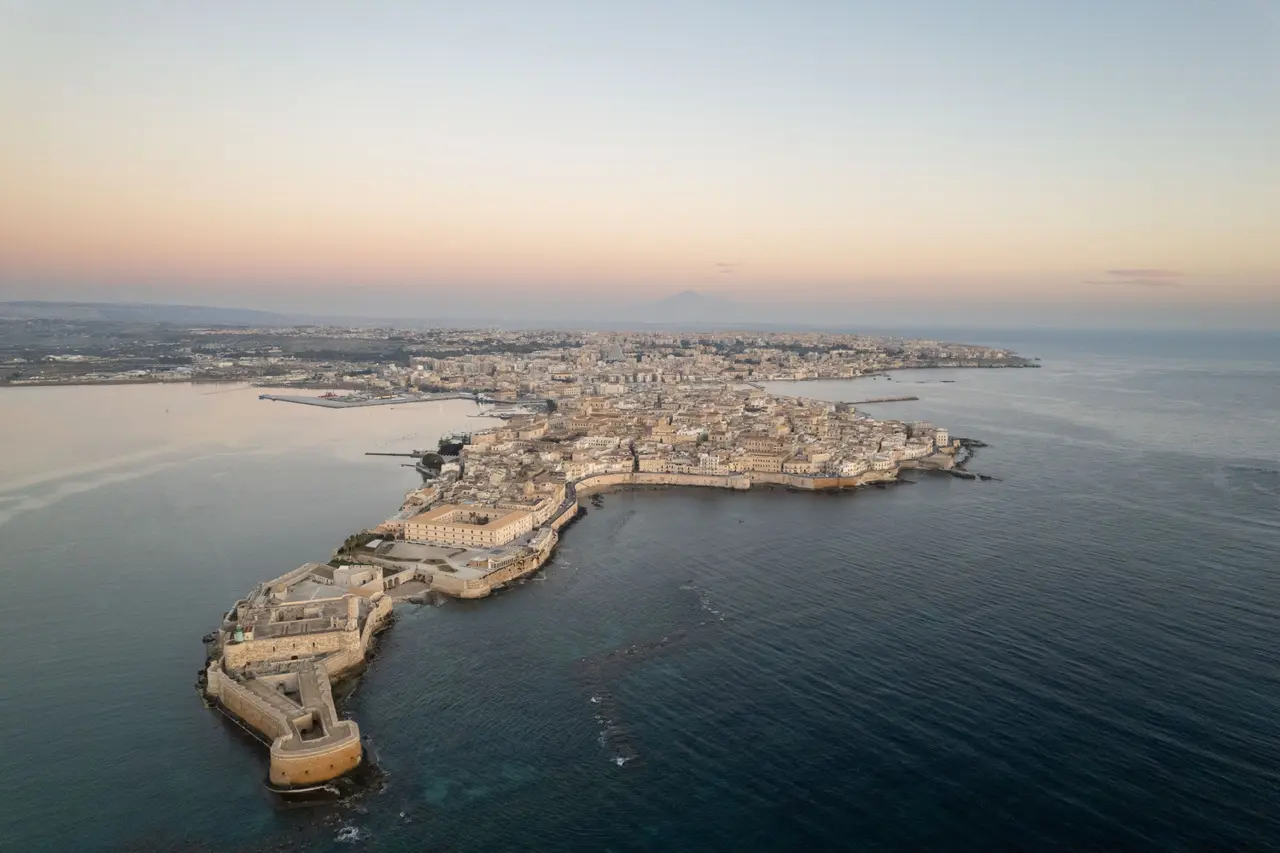


Ortygia is the ancient heart of the city. No matter how much time a visitor can spend there, it will never truly be enough, so perhaps the best thing to do is to get lost in its labyrinth of alleyways and neighborhoods, rather than follow a specific itinerary. Syracuse’s fortunes during the Renaissance-humanist period began and ended, in a sense, with Ortygia, a true tapestry of layers of urban fabric from the Middle Ages to the 18th century. Discoveries can happen around every corner, and multiply in unexpected ways.
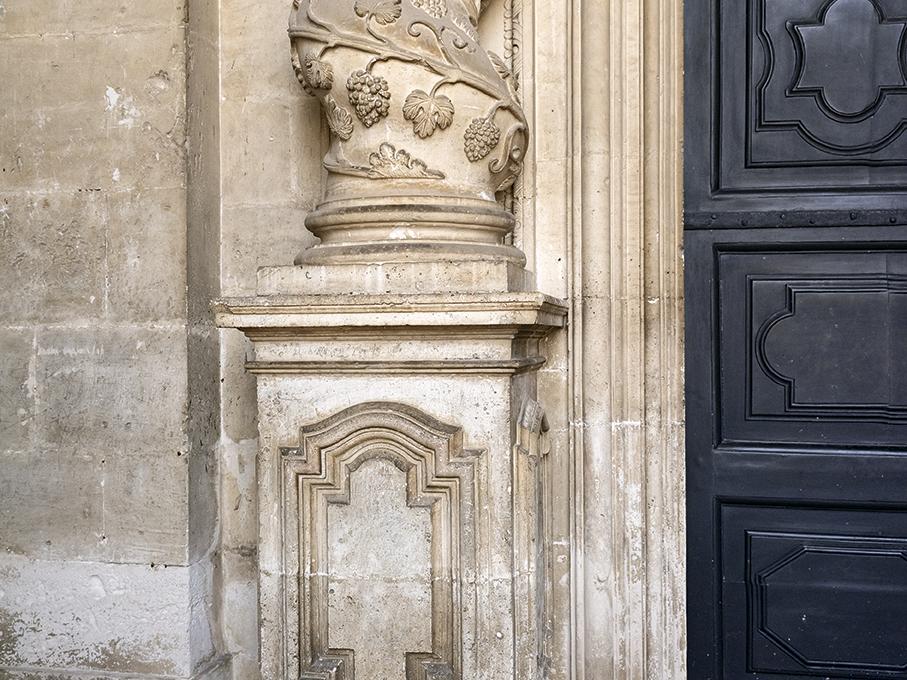
Ever since Archias landed on Ortygia and founded the city, the island has been the political and symbolic heart of Syracuse. Ovid seems to mention the ancient walls of the city in the Metamorphoses (5, 407-408): “and where the Bacchiadae, a race born of Corinth between two seas / had built a city’s walls between unequal harbors.” Those walls were then incorporated into the urban reorganization plan conceived by Dionysius I, and his son Dionysius II, the wine-loving tyrant who earned Plato’s disdain, transformed the entire island of Ortygia into a fortified private citadel for the exclusive use of his lavish government.
The temple of Apollo, rediscovered in 1862, is almost a sort of entrance gate to Ortygia: a pair of columns with Doric capitals still stand, supporting a small fragment of an architrave. It has always topped the list of monuments to see in the city, and rightly so, especially as it is the most ancient of Syracuse’s temples, dating to 580 BC according to Mertens. It is also often noted to be the earliest Doric peripteros in Sicily, a precedent that would prove to have far-reaching influence, as attested by the only integral example left to us, the temple of Segesta, built more than a century and a half later. In the Middle Ages, the temple of Apollo was transformed into a church, and later into a mosque; traces of these sequential palimpsests are clearly visible.
The ancient city’s decumanus ran along what are now Via Dione and Via Roma. This is the visitor’s ideal path, preferable to the Fascist-era (1934-1936) main street, Corso Matteotti, which significantly altered the city’s urban fabric. Near Piazza Archimede, there are a few very interesting Gothic elements, like the recently-restored Palazzo Mergulese-Montalto (1397), with double- and triple-light mullioned windows in Chiaramontano style on the façade and an interior loggia.
The decumanus leads to Piazza del Duomo, the center of the pòlis since the Greek settlement was established; the zone was inhabited in pre-Hellenic times as well. At the peak of Syracuse’s ascendancy, two majestic Ionic temples stood side by side here. The first was dedicated to Athena, and the Duomo was built upon its foundation and vestiges, with a façade designed by Andrea Palma (design dated 1728, work completed in 1754) and adorned with sculptures by Ignazio Marabitti (1746). After the 1693 earthquake made a new façade necessary, the Trapanese architect, having won a competition for the appointment, was explicitly asked to replicate the design of the façade of Santa Maria in Campitelli in Rome, conceived by Carlo Rainaldi. But in Syracuse the overall effect is completely different than in Rome, perhaps thanks in part to the presence of five figures—the Virgin and saints Peter, Paul, Lucia and Marcian—dreamt up by Marabitti, a triumph of variegated vivacity that seems to resurrect archetypal characters from Greek tragedy.
The celebrated Greek columns incorporated into the Duomo’s walls are one of the stories contained elsewhere in this book (see pp. 136-141), so here we will limit ourselves to noting the major artworks inside the church. The important silver statue of Santa Lucia, created in 1599 by Pietro Rizzo, with its silver chest base attributed to Annibale Gagini (1611), is kept in a purpose-built niche in the first chapel on the right, opened only for processions and celebrations. The next highlight is the Chapel of the Sacrament, frescoed by one of Sicily’s most refined 17th-century painters, Agostino Scilla, thanks to contacts cultivated in Messina with the network of art connoisseurs in the orbit of Antonio Ruffo. Moving towards the sacristy we come to the Chapel of the Crucifix, with Antonello da Messina’s oldest known work, a San Zosimo. The saint, already a modern, pyramidal composition, stands against a gold background wholly embellished with foliated scrolls, reflecting the Iberian tradition that dominated the island in the mid-15th century. On the left side of the Duomo’s interior, a series of niches hold a few early 16th-century sculptures: a noteworthy Madonna della Neve by Antonello Gagini, from 1512, is a studied response to Raphael-esque innovations seen in Florence in the years leading up to that date.
The second temple may have been dedicated to Artemis, but its construction seems to have stopped with the end of Gelon’s tyrannic rule. Not far from its site, in 1618, the city government decreed that a new palazzo was to be built for its Senate, and an initial design was prepared by Giovanni Vermexio, one of the major proponents of Syracuse Baroque architecture. Work began in 1629, and continued with inspired decorative and formal features, most likely under the guidance of the Florentine Gregorio Tedeschi. Today, the palazzo serves as the City Hall, and some of its rooms are often visitable during temporary exhibitions. Opposite Palazzo Vermexio is one of Syracuse’s most interesting 18th-century buildings, Palazzo Beneventano del Bosco, designed by Luciano Alì (1779-1788); we can catch a glimpse of the courtyard with its splendid rear wall, a perspective-amplifying composition of paired columns.
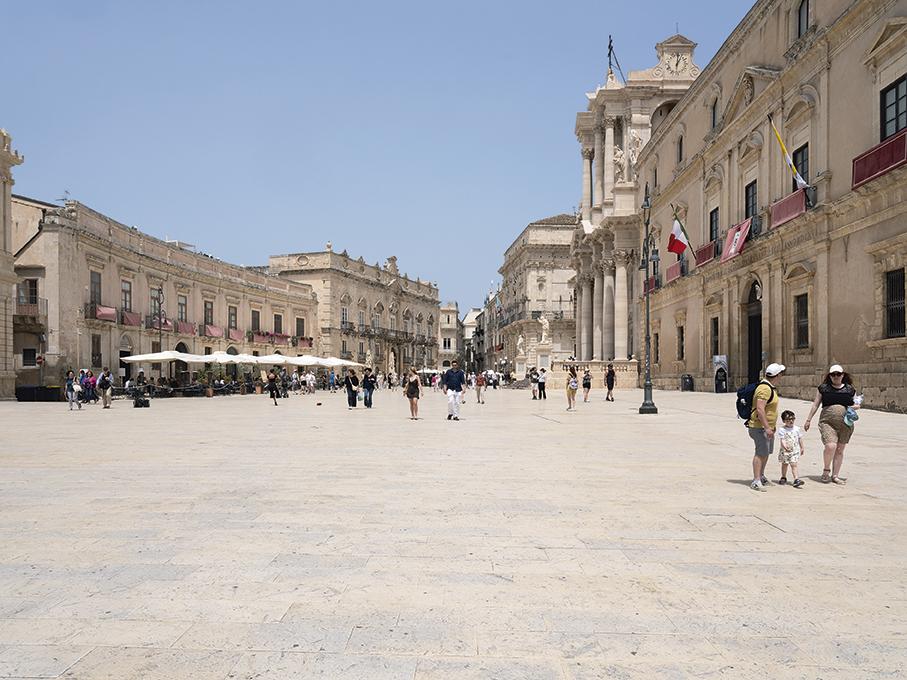
Alongside the Duomo, the archbishop’s palace now hosts the Museo Diocesano, which is well worth a visit, in part for the quality of its architecture; like the Senatorial palazzo, it was also designed in 1618. The short side of the piazza boasts two churches, Santa Lucia alla Badia, rebuilt by Luciano Caracciolo after the 1693 earthquake, and Montevergini, the work of Andrea Vermexio. On the other side of Via Picherali is Palazzo Borgia Impellizzeri, notable for its corner balcony and interiors that mark the beginning of Syracuse’s Rococo period.
Taking the street that runs towards the marina, we come to the Arethusa Spring (see pp. 200-217), a site that has inspired poets and writers throughout history. Patrick Brydone, the Scottish author who contributed to making Sicily a popular leg of the Grand Tour, wrote of seeing washerwomen here in place of the nymphs he had expected to find. According to myth, the nymph Arethusa was the obsession of the infatuated hunter Alpheus; when she rejected him, he transformed himself into a river so he could join his beloved, who had fled to Syracuse to escape him. The metamorphosis explains the presence of freshwater in a spring mere meters from the sea. The spring’s current basin was constructed in 1843.
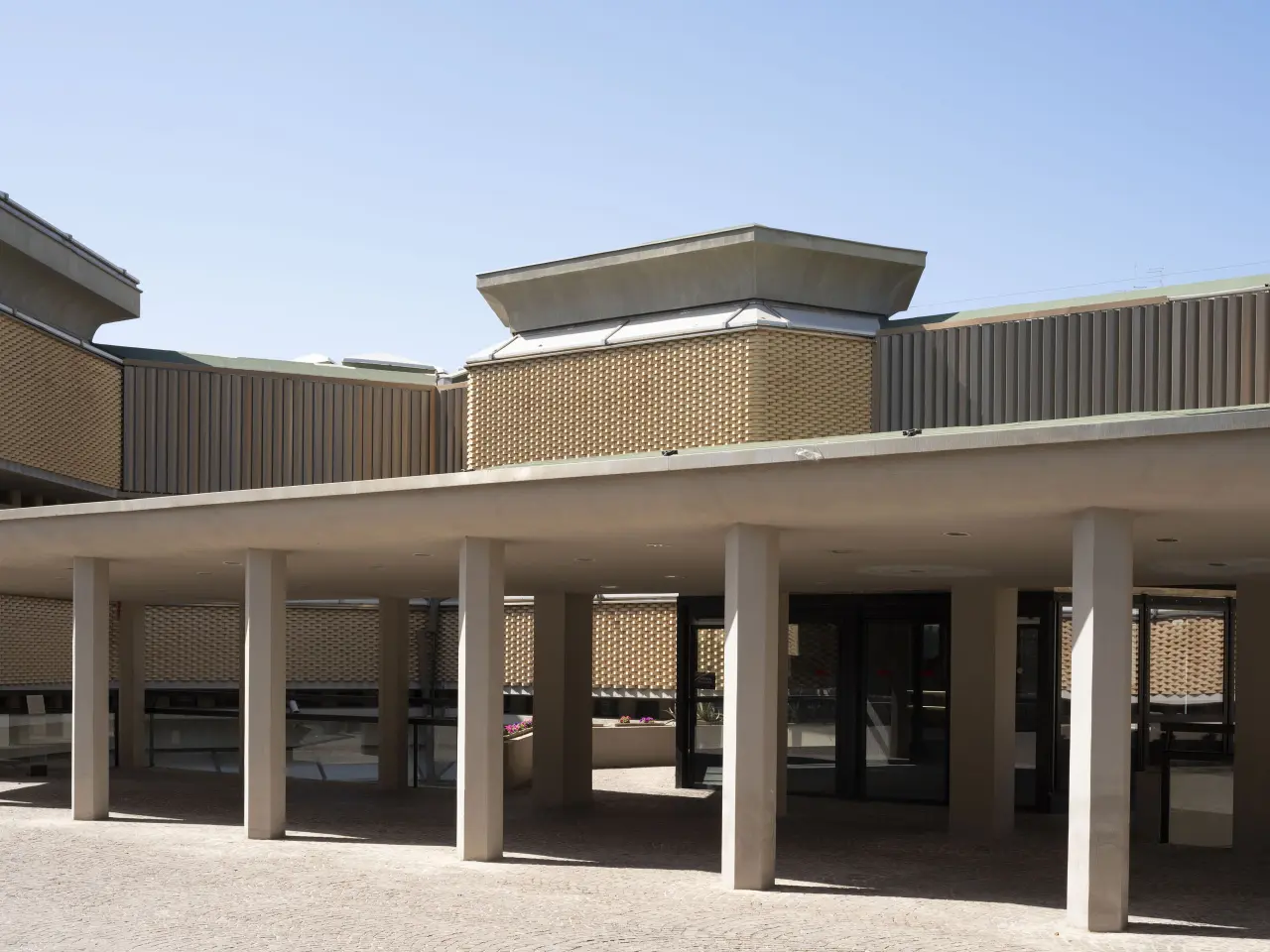
Continuing along Via Capodieci, an essential stop is the Galleria Regionale in Palazzo Bellomo, which conserves Syracuse’s artistic heritage from the Middle Ages to the 19th century (for more on Antonello da Messina and Francesco Laurana, see pp. 150-161). The palazzo has a 14th-century architectural structure, but the most striking elements, like the courtyard, the porticoes, and the exterior staircases, date to the 15th century and betray a Catalan influence. The building’s current layout as an art museum (since 2009), initially suggested in the post-WWII period and completed in 1958, did not become definitive until the transfer of archeological materials to the museum dedicated to Paolo Orsi (for more on which see pp. 170-173). On the ground floor, the museum takes visitors through fragments of the history of sculpture and painting in Syracuse from Late Antiquity to the Renaissance. In these exhibition rooms, the standout figure is an anonymous painter long known as the “Maestro di Santa Maria,” eastern Sicily’s leading proponent of the most elegant strain of International Gothic painting in the early 15th century. His masterpiece is the San Lorenzo Altarpiece, for which the painter was likely influenced by Florentine models he saw and absorbed in Valencia. The Madonna del Cardillo,displayed on the first floor, is a major work by Domenico Gagini, the master most responsible for promulgating Renaissance innovations in Sicily in the late 15th century. The generally established dating of this sculpture to 1492 lets us compare it with early works by Domenico’s son Antonello Gagini, another titan of Italian art history. The sarcophagus cover he sculpted for Giovanni Cardinas (1506) is a high point in marble portraiture, the fruit of his father’s example and a recent journey to Florence for a collaboration with Michelangelo. As for the rest of the museum, which covers the evolution of Syracuse’s art history in the 17th and 18th centuries, highlights include Filippo Paladini’s sketchbook, Mario Minniti’s Caravaggio-esque works (see pp. 160-163), and the decorative arts collections, in particular the wax models and the nativity scene sculptures.
Before leaving Ortygia, visitors will want to see Castello Maniace, the fortress built to defend the city in the Greek era, but substantially reconstructed by Frederick II between 1232 and 1240. It was named for George Maniakes, a Byzantine general who took command of Norman and Lombard mercenary troops in the war against the Arabs. Syracuse was the most important of the thirteen cities he managed to take back between 1038 and 1040 with his personal militia. The castle’s square layout with towers at the four corners was clearly designed during the period that gave us the greatest exemplars of Swabian architecture, like Castello Ursino in Catania, Castel del Monte in Puglia, and Castello dell’Imperatore in Prato. Scholars have identified Riccardo da Lentini as the architect tasked with creating these magnificent fortifications. Syracuse needed a castle in particular to repel the revolts against the emperor that broke out in 1233-1234. The hypostyle hall is one of the most evocative spaces in the city, and there are few comparable rooms in Italy, or in Europe for that matter, in terms of offering a sense of the majesty of 13th-century architecture. The soaring ribbed ceiling vaults and pointed arches generate a grandeur, heightened by capitals adorned with geometric foliage. In Frederick II’s day, signaling a renewed interest in classical art, two celebrated bronze rams from the Hellenistic period were displayed in two niches in the castle; only one has survived until today, and is conserved at the Museo Archeologico Antonino Salinas in Palermo.
